
Was CEO Jensen Huang too big to fire?
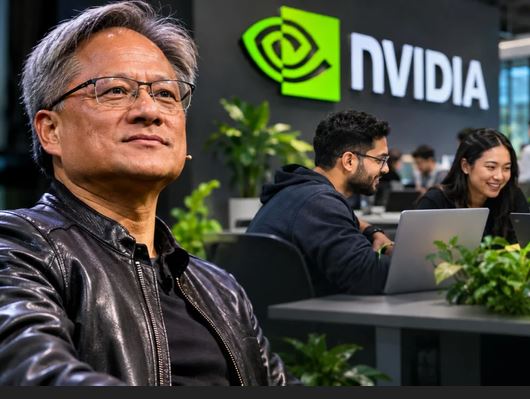
As published by CEO World Magazine -Rick Andrade
You are the founder and CEO of Nvidia, one of the world’s largest companies with annual sales expected to top $300 billion a year and a market cap of $4 trillion on Wall Street. Your company has a 90% share of the AI accelerator GPU chip market on the planet. The world is your oyster.
So why in the world would you allow yourself to become sexually entangled in an affair that could jeopardize it all?
Maybe you’re thinking, “This is my life. I founded the company. I’ll do as I please.” And yes, hubris and ego account for the lion’s share of it.
But according to a 2011 research paper by Joris Lammers and Janka Stoker, power and infidelity go hand in hand.
Their coauthored paper, “Power Increases Infidelity Among Men and Women,” spotlights the results from a survey of 1,561 professional men and women which discovered the greater the power they have, the greater both male and female executives reported infidelity and intentions to be unfaithful.
The conclusion is that “power” attracts people around you. But when a sexual moment presents itself, do you play by the rules or toss caution to the wind?
Most CEOs do have plenty of self-control. But many have also paid the ultimate price for extramarital affairs inside the company. Jeff Bezos, on the other hand, got away with his adultery because his lady friend didn’t work at Amazon. Is that enough?
What if your lover is Alice Huang (no relation), young, attractive, very attentive, and half a world away?
What if she was more than just a fling?
What if your lover was also a Chinese spy and former executive at Singapore-based cloud computing company Megaspeed International, an alleged Chinese front company accused of funneling prohibited Nvidia AI semi-chips to China, bypassing strict U.S. export controls?
Would you know better?
Megaspeed itself was no small-time customer.
What we do know is that the company emerged as a massive customer account for Nvidia in Southeast Asia over the past few years, purchasing roughly $5 billion worth of advanced AI hardware.
And if Jensen Huang knew who she was, which is unclear, and continued the affair, it would very likely spell curtains for the chief executive, would it not?
But now add another sexual misconduct claim against the embattled CEO, this time the accuser is a direct report inside Nvidia.
As a result, Nvidia co-founder Jensen Huang has resigned as CEO, a shocking end to the tech titan’s career at the company.
The Fallout
In nearly every case, absent criminal conduct, it was the board of directors making the final call on the CEO’s firing or forced resignation.
But do unethical behaviors in the corner office trump Wall Street?
No. A CEO directly linked to the financial success of any major multinational company does have some cards to play.
In my view, as with most business endeavors in a capitalist country, money talks louder than sex scandals, so long as you don’t explicitly violate company rules.
And most corporate policies do include a Code of Conduct rule book with clauses for all employees, explicitly defining the high moral ground and non-fraternization policy between staffers and management, including the CEO.
But to some CEOs, the rules don’t matter. Jensen Huang is yet another example.
In fact, if you do the research, despite the risks, you’ll find a startling number of high-profile public company CEOs who crossed the line and paid the price for it.
- Brian Krzanich CEO Intel, 2018: resigned for sleeping with a subordinate
- Mark Hurd CEO Hewlett Packard, 2010: resigned for sleeping with a vendor and falsifying expense reports
- Steve Easterbrook CEO McDonald’s, 2019: fired for sleeping with a staffer
- Ashley Buchanon CEO Kohls, 2025: fired for sleeping with a vendor and funneling favorable biz deals
- Harry Stonecipher CEO Boeing, 2005: fired for sleeping with a staffer
- Laurent Freixe CEO Nestle, 2025: fired for sleeping with a staffer
- Alan Shaw CEO Norfolk Southern, 2024: fired for sleeping with a staffer
- Bernard Looney CEO BP, 2023: resigned for sleeping with multiple staffers
- Jeff Shell CEO NBC Universal, 2023: fired for sleeping with a staffer
- Edward Tilly CEO Cboe Global Markets, 2023: resigned for sleeping with multiple staffers
- Laurent Potdevin CEO Lululemon, 2018: resigned for sleeping with a staffer
- Brian Dunn CEO Best Buy, 2012: resigned for sleeping with a staffer
- Bill Gates – Board advisor Microsoft, 2020: resigned after a 20- year-old sexual revelation
And this is the short list.
But not every top dog gets the boot after an affair. Jeff Bezos at Amazon in 2021, Sergey Brin at Google in 2013 and Chey Tae-won, Chairman at SK Hynix (South Korea), all held on. How?
It’s a narrow gap to navigate, but it boils down to whether you directly violated company policy and compromised company ethics and the trust of stakeholders, or whether you own enough controlling equity votes to determine your own fate.
Bezos’ affair was not in-house. Brin and Tae-won held voting control, which kept them in office. In other words, it’s your life. If you want to cheat on your spouse, so be it. But if you own the stock, you own the job, and absent a crime, nobody can fire you.
Unfortunately, Jensen Huang only owns roughly 3.5% of Nvidia, the company he co-founded. Unlike Sergey Brin, Jensen Huang is unprotected from shareholders and the board.
70% of Nvidia is owned by mega investment institutions like Vanguard, BlackRock and Fidelity. None have commented thus far, but all would unlikely want to see the value of their clients’ Nvidia equity holdings tank, and vote him off the island. Rather, they’re more likely to prefer that Jensen stay on in some capacity. But his resignation makes that unlikely.
Media reports say Nvidia CFO, Collete Kress will be the interim CEO until a new leader can be found.
Unfortunately, Jensen Huang was such an integral part of Nvidia operations and strategy, even a capable CFO will not fill his shoes.
He’s simply too irreplaceable, which begs the question:
If Nvidia is too big to fail… Was Jensen Huang too big to fire?
We’ll soon know.
The Takeaway Lessons
Key Man Risk
When you go to Vegas, the last thing you should do is place it all on red and spin.
Yet for many founder-led companies, that’s exactly what happens. This is the fundamental risk behind a company’s reliance on one key person to bring the magic. And Jensen Huang, right or wrong, is that key man.
The lesson here is not about having a Key Man risk; it’s about not having a succession plan in the event you lose the bet.
This international incident with Nvidia not having a number two in the wings, clearly illustrates that lack of succession planning. A board of directors that fails to prepare for the loss of a pivotal key man CEO like Jensen Huang should be held accountable as well.
Super-Voting Shares
There are only a few survival tactics available should the day come when you find your leadership under assault, unfairly or otherwise.
Foremost is to have issued Class B super-voting shares, as Elon Musk, CEO of SpaceX, and Mark Zuckerberg, CEO at Meta, did specifically to ensure “super shares” give them voting control, or some form of unassailable ownership structure control as a founder, should they need it.
Publicly, however, super-voting shares do not absolve CEOs of any culpable acts. We expect and demand more from our public figures, especially CEOs who can lose sight of their massive power and influence to move mountains or destroy them.
So, while the fate of Jensen Huang’s future will largely depend on the outcome of many investigations, needless to say, the controversy and his resignation (firing) leave an indelible stain on his legacy and the AI chip bellwether he co-founded.
The Bottom Line
Executives will always be attracted and tempted by others. The key lesson is finding a way to prevent yourself from taking the forbidden fruit beforehand. Something that may never be universally achieved.
After all, we’re only human, right?